
Custom fabrication
Process skids & custom fabrication
Not everything in a plant fits a product category. If it is rolled, formed, machined or welded, and it has to work under pressure, temperature or load, we can build it — from your drawing or from a scope of work and a conversation.
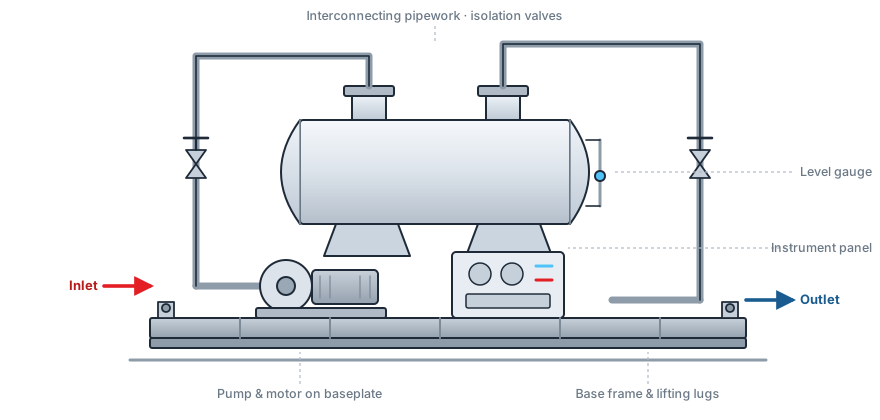
Process skids
Build it in the shop, not on the critical path
A skid moves work off your site and into a controlled shop. It arrives tested, wired and ready to connect, which usually turns weeks of site installation into a lift and a few tie-in welds.
- Fabricated, assembled and function-tested before it leaves the shop
- One structural base frame with lifting lugs and a documented lift plan
- Pipework, valves and instrumentation installed and pressure-tested as a system
- Electrical and control panel mounted, wired and loop-checked
- Minimal site work: set down, connect the terminal points, commission
- Repeatable — the second unit is the same as the first
Typical packages: chemical dosing, filtration, heat transfer, pump sets, CIP units, sampling and metering.
Browse the product catalogue → for specific fabricated components we already list — pipe supports, spectacle blinds, separator internals and more.
What we fabricate
Beyond the standard product range
Pipe spools & manifolds
Shop-fabricated spools, headers and manifolds in carbon steel, stainless and duplex, cut and bevelled to an isometric and marked for site assembly.
Structural steel
Platforms, pipe racks, equipment supports, walkways, stairs, ladders and handrails, with hot-dip galvanising or a paint system.
Hoppers & chutes
Conical and pyramidal hoppers, transfer chutes and diverters, with wear plate or liners where the material is abrasive.
Ducting & stacks
Round and rectangular ducting, expansion joints, dampers, cyclones and stacks for gas handling and dust extraction.
Rolled & formed sections
Cylinders, cones, transitions and formed heads rolled and pressed to your dimensions, supplied loose or welded up.
Machined components
Tubesheets, flanges, shafts, spacers, bushes and wear parts turned and milled to drawing tolerance.
Frames & base plates
Pump baseplates, motor frames, machine bases and skid frames, stress-relieved and machined flat where alignment matters.
Repairs & modifications
Nozzle additions, shell patching, support strengthening and re-rating of existing equipment, with the calculations to back the change.
Reverse engineering
Obsolete part with no drawing? We measure the original, produce a drawing, and make a replacement — often in an upgraded material.
Shop processes
What we can do to metal
Cutting
Plasma, oxy-fuel, saw and shear cutting with edge preparation and bevelling.
Rolling & bending
Plate rolling for shells and cones; press braking for brackets and formed sections.
Pressing
Dished head forming, flanging and knuckle forming, hot or cold as the material requires.
Welding
SMAW, GTAW, GMAW, FCAW and SAW to qualified WPS with certified welders.
Machining
Turning, milling, drilling and boring, including tubesheet drilling and grooving.
Tube expansion
Roller and hydraulic expansion, with seal or strength welding where specified.
Heat treatment
Post-weld heat treatment and stress relief with a recorded chart.
Surface prep
Abrasive blasting, pickling and passivation, mechanical polishing.
NDT
RT, UT, MT, PT and visual examination to the agreed inspection and test plan.
Pressure testing
Hydrostatic and pneumatic testing, plus helium leak testing where required.
Coating
Multi-coat paint systems, galvanising and internal lining application.
Assembly & test
Mechanical assembly, alignment, rotation checks and function testing before dispatch.
How to engage us
Three ways in, depending on how far along you are
Build to print
You have complete drawings and a specification. We quote, fabricate and test exactly to them — and tell you before we start if we spot something that will not pass a code check or cannot be welded as drawn.
Design & build
You have a duty, a footprint and a code. We do the process and mechanical design, issue drawings for your approval, then build. The single most common route.
Solve a problem
Something in the plant is not performing, keeps failing, or nobody knows what it was designed for. We survey it, work out why, and propose a fix or a replacement.
Have a drawing, or just a problem?
Either is a fine place to start. Send what you have and we will tell you what it takes.