
Mixers & agitators
Agitators selected for the duty, not the catalogue
“Mixing” covers at least five different physical jobs, and the impeller that is right for one is wrong for another. Tell us what the fluid has to do and we will select the impeller, speed, shaft and seal to do it.
Mixing duties
Which of these is actually your problem?
This is the first question we will ask, because it determines whether you need flow or shear — and those pull the design in opposite directions.
Making two miscible liquids uniform
Needs bulk flow, not shear. A large-diameter, low-speed axial impeller turns the whole batch over with minimum power. Judged on blend time.
Keeping solids off the bottom
Needs enough velocity at the tank floor to lift and carry particles. Judged against just-suspended speed, which depends on particle size, density difference and solids loading.
Breaking one phase into another
Gas into liquid, or immiscible liquid into liquid. Needs high local shear at the impeller tip — a radial-flow turbine, sometimes with a second impeller for bulk circulation.
Moving batch heat to the wall
Needs flow along the jacketed surface. Wall-scraping or close-clearance impellers stop a stagnant film forming on the heat transfer surface.
Moving fluid that does not want to move
Laminar regime. Anchor, helical ribbon and screw impellers physically push material rather than relying on turbulent momentum transfer.
Growing floc without shearing it apart
Very gentle, controlled velocity gradient. Paddle and picket-fence agitators at low tip speed, in water and wastewater treatment.
Anatomy
The drive is the cheap part
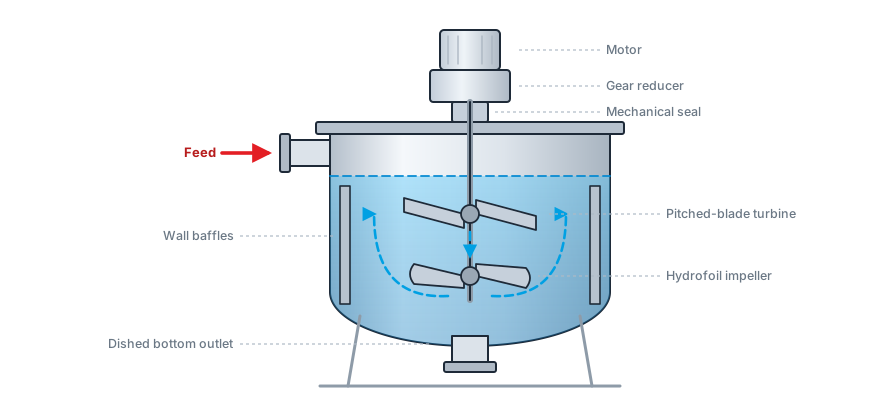
Motors and gearboxes are bought in. The engineering is in the shaft, the impeller selection, the seal and the baffles — and that is where mixers go wrong.
- Motor sized on absorbed power at the highest-density condition, not the normal one
- Gear reducer setting shaft speed; helical or bevel-helical, with an overhung load rating
- Shaft checked for torsion, bending, deflection and critical speed — never just torque
- Seal lip, packed gland, single or double mechanical, or magnetically coupled for zero leakage
- Impellers one or several, positioned by liquid depth and duty
- Baffles normally four at the wall, to convert swirl into useful top-to-bottom flow
- Steady bearing at the shaft foot on long shafts, where deflection would otherwise govern
The single most common failure we are asked to fix: a shaft sized on torque alone, run near its critical speed, that whips and destroys the seal.
Impeller selection
Flow or shear — you cannot maximise both
For the same power input, an impeller either moves a lot of fluid gently or a little fluid violently. Pick according to the duty.
| Impeller | Flow pattern | Bias | Best for |
|---|---|---|---|
| Hydrofoil | Axial | Highest flow per unit power | Blending, mild solids suspension, heat transfer |
| Pitched-blade turbine (PBT) | Axial with a radial component | Balanced flow and shear | General-purpose workhorse; solids suspension |
| Rushton / flat-blade turbine | Radial | High shear | Gas dispersion, liquid–liquid dispersion |
| Concave-blade turbine | Radial | High shear, better gas handling | Gas–liquid duty at high gas rates |
| Sawtooth / cowles disc | Local, high intensity | Very high shear | Pigment dispersion, emulsification, wetting-out powders |
| Anchor | Close to the wall | Bulk movement in laminar flow | High viscosity, jacketed heat transfer |
| Helical ribbon | Top-to-bottom, positive displacement | Bulk movement at very high viscosity | Pastes, gels, polymers |
| Paddle / picket fence | Gentle radial | Very low shear | Flocculation and delicate solids |
Shafts & seals
Where the mixer meets the vessel
Lip seal
Open or low-pressure tanks. Keeps dust and splash out; not a containment device.
Packed gland
Simple, repackable, tolerant of shaft movement. Accepts a small controlled leak.
Single mechanical seal
Pressure or vacuum service with low emissions. Needs clean flush and correct shaft run-out.
Double mechanical seal
Barrier fluid between two seal faces. For toxic, sterile or valuable contents.
Magnetic drive
No shaft penetration at all. The only true zero-emission answer for hazardous duty.
Critical speed check
Operating speed kept clear of the shaft's natural frequency, with the margin stated.
Steady bearing
Bottom support on long, slender shafts. Adds a wear part, so used only when needed.
Removable in situ
Drive and seal detailed so they can be serviced without draining or entering the vessel.
Design envelope
Specification options
To quote a mixer we need: vessel diameter and straight side, batch volume, fluid viscosity and density, solids loading and particle size if any, temperature, pressure, and the mixing result you are trying to achieve.
Mixing problem to solve?
Describe the batch and what it needs to do. We will select and size the agitator.