
Reactors
Jacketed, agitated reactors
A reactor is three pieces of equipment in one shell: a pressure vessel, a heat exchanger and a mixer. All three have to be designed together, because the jacket you pick changes the heat transfer, and the agitator you pick changes how well the jacket works.
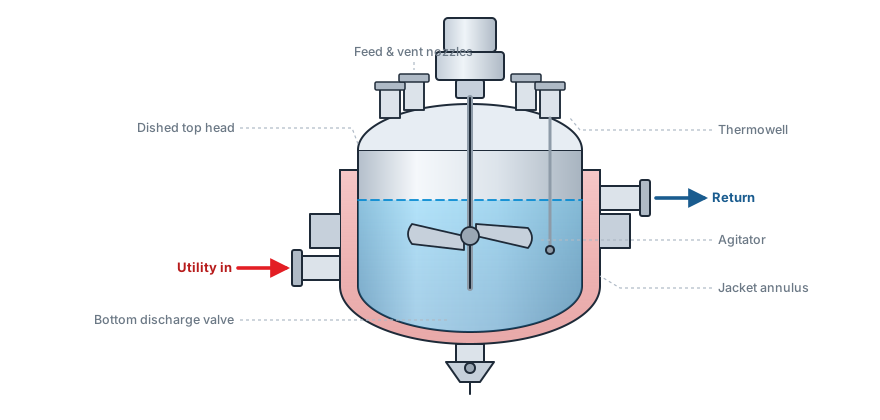
Anatomy
Three disciplines in one weldment
- Inner shell the pressure envelope holding the batch, designed to ASME VIII Div. 1
- Jacket a second envelope carrying steam, hot oil, water or glycol — itself a pressure part
- Dished heads top and bottom, giving strength and letting the vessel drain completely
- Agitator impeller selected for the reaction, and for scraping the heat transfer wall clean
- Top-head nozzles feed, vent, relief, sight glass, light, thermowell, sample and CIP
- Thermowell reaching into the batch, so you measure the contents and not the wall
- Bottom outlet flush-mounted valve so nothing is left behind between batches
- Supports lugs or legs, with the jacket loads and the agitator moment carried properly
Jacket types
Three ways to heat a vessel wall
The choice is a trade-off between pressure rating, heat transfer coefficient and how much plate it takes.
| Type | Utility pressure | Heat transfer | Utility volume | Best for |
|---|---|---|---|---|
| Conventional annular jacket | Low to moderate | Modest — flow tends to channel unless baffled | Large | Steam heating, simple and economical duty |
| Dimple jacket | Moderate | Good — turbulence is created by the dimples | Small | Fast temperature response, thin-wall construction |
| Half-pipe (limpet) coil | High | Best — a defined, high-velocity flow path | Smallest | High-pressure utility, tight temperature control, zoned heating |
| Internal coil | High | High area in a small footprint | Small | Large duty; accepted where an internal surface is tolerable |
Why a limpet coil often wins
Because the utility is confined to a narrow channel, velocity is high and predictable, so the coefficient is high and the response is fast. It also takes far higher utility pressure than an annular jacket, and it can be split into zones so a part-filled vessel is not heated above the liquid line.
Why an annular jacket still sells
It is the cheapest to fabricate and perfectly adequate for condensing steam, where the coefficient is set by condensation rather than by velocity. For a straightforward steam-heated batch it is often the right engineering answer as well as the cheap one.
Heating & cooling
Getting the batch to temperature, and holding it there
Steam heating
Simple, high coefficient, self-regulating on pressure. Needs proper condensate removal and air venting or the jacket waterlogs and the duty collapses.
Hot oil / thermal fluid
For temperatures above what steam can reach at a sensible pressure. Single-fluid systems can also cool, so one circuit does both.
Water & glycol cooling
Tempered water or glycol for exothermic reactions and for crystallisation, where the cooling ramp rate matters as much as the endpoint.
Electric heating
Trace or cartridge heating for small vessels and for holding temperature where a utility circuit is not justified.
Exotherm control
Where the reaction generates its own heat, the cooling capacity has to exceed the peak rate — not the average. We size against the runaway case.
Zoned jackets
Separate jacket zones so a partially filled reactor is not heated on a dry wall, which would bake product onto the surface.
Sanitary construction
For food, beverage and pharmaceutical duty
Hygienic design is geometry first and polish second. A beautifully polished vessel with a dead leg in it will still fail a swab test.
Fully drainable
Dished bottom, flush outlet valve, no horizontal ledges and no low points that hold liquid.
Crevice-free welds
Full-penetration internal welds ground and blended flush, with no gaps for product to lodge in.
Documented finish
Mechanical polish or electropolish to an agreed Ra value, with measurements recorded.
CIP coverage
Sprayballs positioned and sized so every internal surface, including the agitator, is wetted.
Hygienic fittings
Tri-clamp and aseptic connections instead of flanges with exposed gasket faces.
Zero dead legs
Branch lengths kept within accepted limits so nothing stagnates between batches.
Passivation
Pickled and passivated after fabrication to restore the chromium oxide layer.
Material traceability
Certificates for every product-contact component, including gaskets and seals.
Design envelope
Specification options
To quote a reactor we need: working and total volume, design pressure and temperature on both the process and utility sides, the batch fluid and its viscosity, the reaction heat duty and ramp rate, materials of construction, and whether sanitary construction applies.
Reaction to run?
Send the batch data and the heat duty. We will design the vessel, jacket and agitator together.