
Shell & tube
Shell & tube heat exchangers to TEMA
The most forgiving exchanger you can specify: it takes pressure, it takes temperature, it takes dirty fluids, and when it fouls you can open it and clean it. We build all the standard TEMA configurations and detail them so they can actually be maintained.
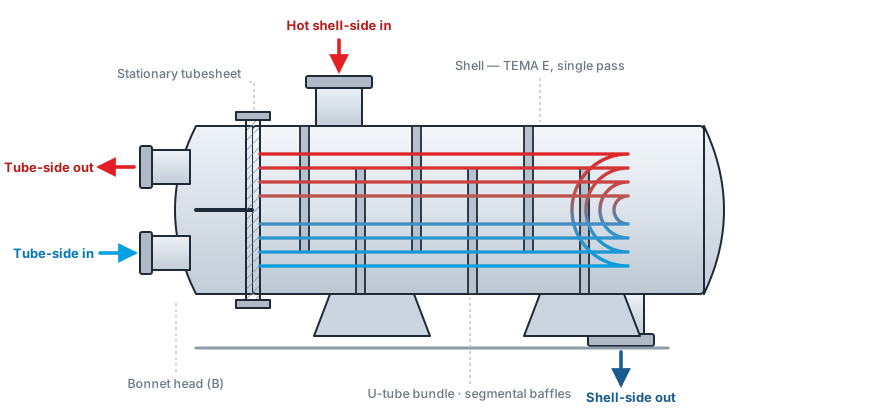
Anatomy
Every part earns its place
Read the drawing left to right and the flow path makes sense. Cold fluid enters the bottom of the bonnet, travels the length of the tubes, turns at the U-bends, comes back through the upper half and leaves hot. Meanwhile the shell-side fluid is pushed across the bundle by the baffles.
- Shell — the pressure envelope for the outer fluid, rolled from plate or cut from pipe
- Tube bundle — the heat transfer surface; the part that decides cost and life
- Tubesheet — drilled plate the tubes are expanded or welded into, separating the two fluids
- Baffles — force cross-flow over the tubes and support them against sagging and vibration
- Front head / channel — distributes tube-side flow; a pass partition creates multiple passes
- Rear head — fixed, floating or simply absent on a U-tube bundle
- Nozzles & supports — sized for allowable pressure drop and detailed for the loads they carry
From our design office
The same parts, as we model them
Click any image to enlarge.
TEMA designations
Reading the three-letter code
TEMA describes an exchanger with three letters: front head, shell, rear head. Our BEU walkthrough video shows one of these in full. Expand any row below for what the letter actually means.
B bonnet (integral cover) front head, E one-pass shell, U U-tube bundle. Because the tubes bend back on themselves, there is only one tubesheet and nothing restrains the bundle from expanding — so this handles large temperature differences without an expansion joint. The bundle pulls out of the shell for external cleaning.
Best for: clean tube-side fluid, dirty shell side, big temperature difference. Limitation: you cannot mechanically clean inside a U-bend, and individual tubes cannot be replaced — only plugged.
Tubesheets welded to the shell at both ends. The cheapest and tightest arrangement, with no internal gaskets to leak between the two fluids. Straight tubes mean the tube side can be rodded or hydro-blasted end to end.
Best for: clean shell side, dirty tube side, moderate temperature difference. Limitation: the bundle cannot be removed, so the shell side must be chemically cleaned; large differential expansion needs a shell expansion joint.
A channel with a bolted flat cover, E one-pass shell, S floating head with a backing device. The most maintainable configuration there is: you can get at the tube ends without disturbing the piping, and the whole bundle still comes out.
Best for refinery and petrochemical service where both sides foul and inspection intervals are short. Trade-off: the most expensive and the longest of the family.
Channel and tubesheet integral with the shell at both ends. Very compact and economical, common in utility and HVAC duty and in small pressure ratings.
Best for clean-on-clean service and tight footprints. Limitation: the least accessible of the family for maintenance.
K is an enlarged kettle-type shell, giving vapour space above the liquid so boiling can happen without carrying droplets over into the outlet.
Best for reboilers, vaporisers and steam generators.
One or more tubes inside an outer pipe, bent into a U. Genuinely counter-current, so it can achieve a close temperature approach or handle a temperature cross that a single shell-and-tube pass cannot. Add hairpins in series or parallel to scale the duty.
Best for small duties, high-pressure service, viscous fluids and close approaches. Longitudinal fins can be added to the inner tube where the outside coefficient is poor.
Not sure which letters you need? Describe the service and we will propose a configuration with the reasoning attached.
Choosing between them
Maintenance decides more than price
The cheapest exchanger to buy is often the most expensive to own. This table is the honest comparison.
| Configuration | Bundle removable | Mechanical cleaning | Differential expansion | Relative cost |
|---|---|---|---|---|
| Fixed tubesheet (BEM / NEN) | No | Tube side only | Needs expansion joint if large | Lowest |
| U-tube (BEU) | Yes | Shell side and straight tube runs | Accommodated freely | Low to medium |
| Floating head (AES / AET) | Yes | Both sides, fully | Accommodated freely | Highest |
| Double tubesheet | Depends on rear head | As base type | As base type | Medium to high |
| Hairpin / double-pipe | Yes | Both sides | Accommodated freely | Low in small duties |
Double tubesheet
Two tubesheets with a vented gap between them, so a tube-to-tubesheet leak escapes to atmosphere instead of cross-contaminating. Specified where mixing the two fluids is unacceptable — potable water, pharmaceutical and food duty.
Multi-pass arrangements
Pass partitions raise tube-side velocity, which lifts the heat transfer coefficient and keeps tubes from fouling. The cost is pressure drop and a small LMTD correction, both of which we account for in the rating.
Sanitary construction
Fully drainable geometry, no dead legs, crevice-free tube-to-tubesheet joints and a documented internal finish. Tube-in-tube is often the cleaner answer for genuinely hygienic duty.
Design envelope
What we can build
Ranges below are indicative. If your duty sits outside them, ask anyway — the answer is often yes, or a two-shell arrangement.
Detailing
The details that decide whether it lasts
Tube-side velocity
Too low and the tubes silt up and the coefficient collapses. Too high and you erode the tube inlets, especially in copper alloys. We target a window that keeps the surface self-cleaning without eating the metal.
Flow-induced vibration
Unsupported tube spans that are too long will vibrate against the baffles and wear through at the contact points. Baffle pitch is checked against the shell-side crossflow velocity, not just chosen for pressure drop.
Impingement protection
A high-velocity shell inlet aimed straight at the outer tube row will cut through it. Where the inlet momentum warrants it, we fit an impingement plate or a distributor belt.
Venting and draining
Nozzles placed so the unit can actually be filled, vented and drained in its installed orientation. It sounds obvious; it is the single most common omission we see on units brought to us for repair.
Fouling allowance
Over-generous fouling factors make the exchanger bigger, which lowers velocity, which makes it foul faster. We use realistic resistances for the actual fluid and tell you what we assumed.
Bundle pulling space
A removable bundle is only removable if there is clear length in front of the exchanger to pull it into. We check that against your layout before we call it maintainable.
Common questions
Shell & tube questions we are asked
TEMA describes an exchanger with three letters for front head, shell and rear head. B is a bonnet (integral cover) front head, E is a single-pass shell, and U is a U-tube bundle. Because the tubes bend back on themselves there is only one tubesheet and nothing restrains the bundle from expanding, so a BEU handles large temperature differences without an expansion joint, and the bundle pulls out of the shell for external cleaning.
Maintenance decides it more than price. Fixed tubesheet is cheapest and tightest but the bundle cannot be removed, so the shell side must be chemically cleaned. U-tube allows the bundle out and absorbs differential expansion freely, but you cannot mechanically clean inside a U-bend and individual tubes can only be plugged, not replaced. Floating head is the most maintainable and the most expensive, and is the usual choice where both sides foul.
Not austenitic stainless. Types 304 and 316 pit and suffer chloride stress corrosion cracking in seawater. Use titanium Grade 2 for seawater, brine and hypochlorite, or 90/10 and 70/30 cupronickel for marine cooling water within their velocity limits. Duplex 2205 handles brackish and moderately high chloride water. Admiralty brass suits fresh and brackish water but not ammonia.
The class sets minimum thicknesses, corrosion allowances and construction tolerances. Class R is for severe petroleum service and is the most demanding. Class C is for general commercial and moderate process duty and is the right choice for most utility and industrial exchangers. Class B is for chemical service, with C-like economy but provisions suited to aggressive fluids. Asking for R when you do not need it means paying for metal you will never use.
Ready to specify?
Send the process data sheet and we will return a rated selection with a TEMA designation.