
Thermal equipment
Heat exchangers, sized for your duty
A heat exchanger is only as good as the numbers behind it. We start from your process data — flows, temperatures, fouling, allowable pressure drop — and work back to a geometry that actually hits the duty and stays cleanable in service.
MechaMatic manufactures process equipment under its own name and represents selected international manufacturers in Egypt and MENA. Where the right product for your duty is one we do not build, we will tell you, and we will source and support it. Representation & partnerships
Types we build
Four families cover almost every duty
Which family fits depends on the fluids, the temperature cross, the space you have and how dirty the service is. Here is the short version.
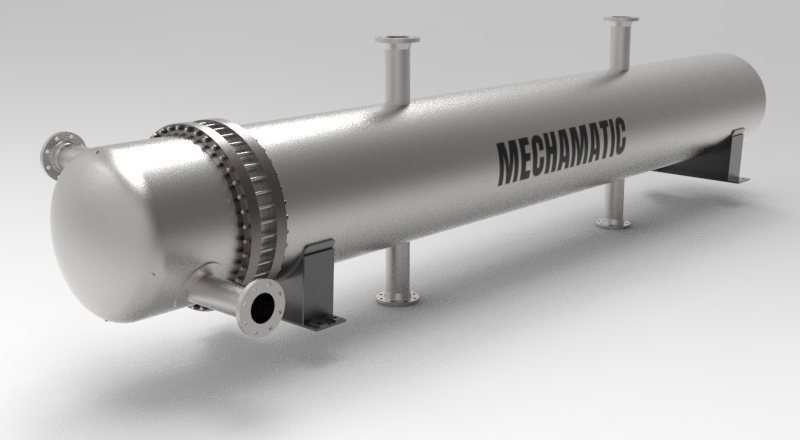
Shell & Tube
The workhorse. Handles high pressure and high temperature, tolerates dirty service, and can be opened for mechanical cleaning. Fixed tubesheet, U-tube, floating head and hairpin configurations to TEMA.
Shell & tube detail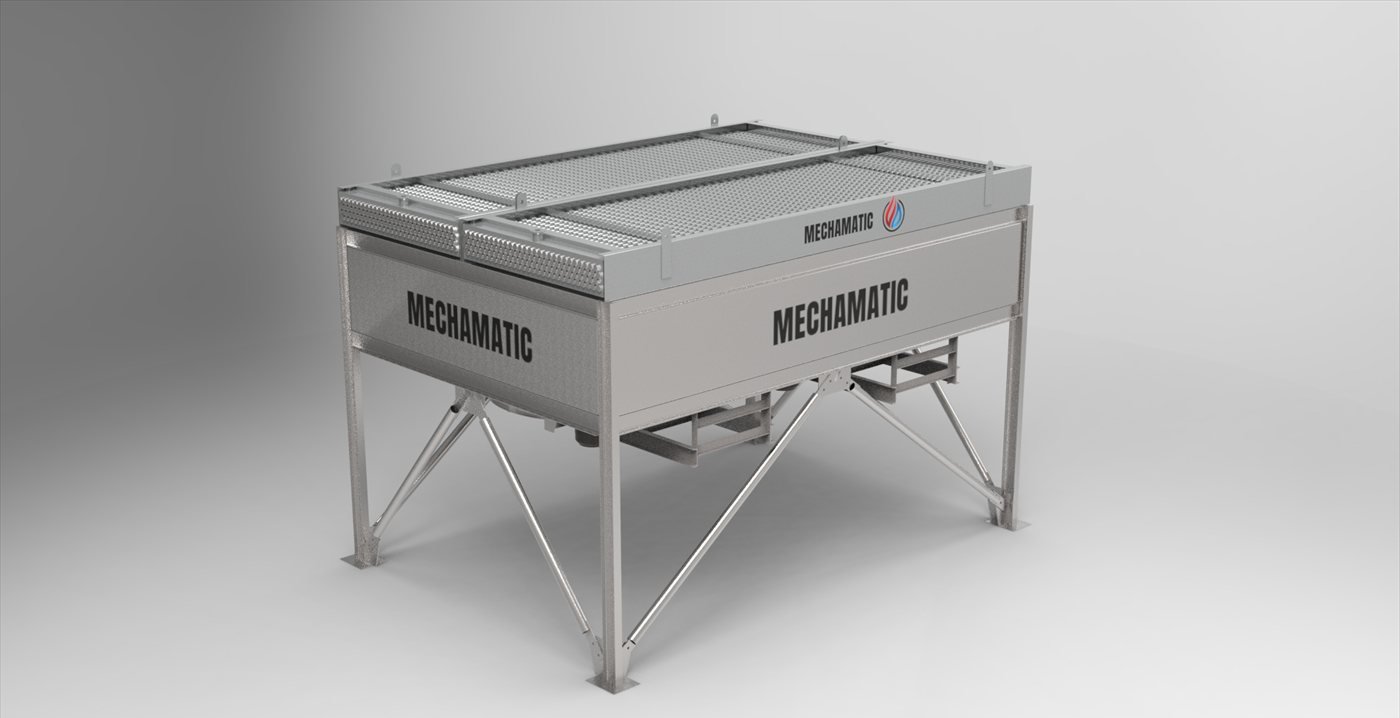
Air-Cooled (Fin-Fan / ACHX)
Rejects heat straight to ambient air, so no cooling tower, no make-up water and no water treatment. The default choice on inland Egyptian and Gulf sites where water costs more than power.
Air-cooled detail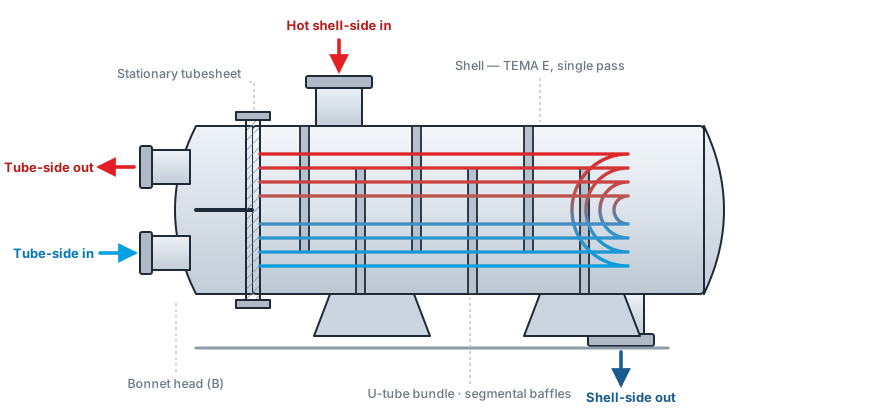
Double-Pipe & Hairpin
One pipe inside another, in a U. Compact, cheap to make in small duties, easy to add to in modules, and genuinely true counter-current — which matters when you have a close temperature approach or a temperature cross.
Quoted on enquiry — tell us the duty.
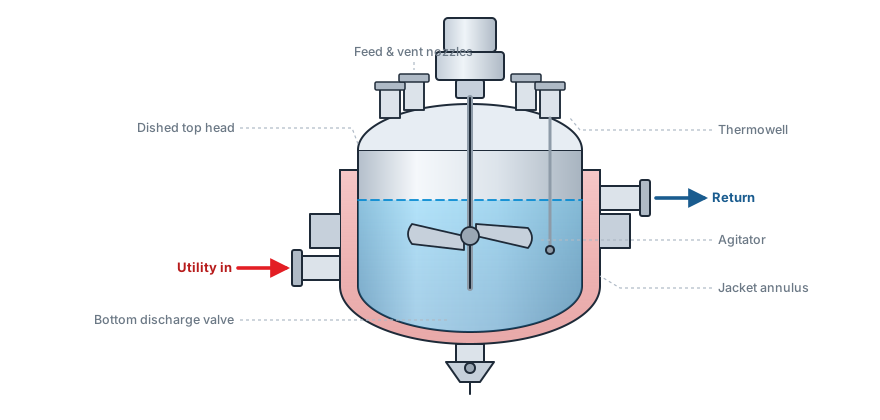
Jackets & Limpet Coils
When the heat transfer surface is the vessel itself. Conventional annular jackets, dimple jackets and half-pipe (limpet) coils for reactors, mixing tanks and crystallisers.
See reactorsHow to choose
A quick selection guide
Not a substitute for a rating calculation, but it will get you to the right family before you pick up the phone.
| If your situation is… | Consider | Why |
|---|---|---|
| No reliable cooling water | Air-cooled (fin-fan) | Removes the cooling tower, make-up water and water treatment entirely. |
| High pressure on one side | Shell & tube | Tubes and a cylindrical shell handle pressure far better than plates or gaskets. |
| Fouling or fibrous fluid | Shell & tube, U-tube or removable bundle | Straight tubes can be rodded or hydro-blasted; the bundle pulls out for access. |
| Large temperature difference between sides | U-tube or floating head | The bundle is free to grow, so differential thermal expansion is not restrained. |
| Close approach or temperature cross | Double-pipe / hairpin, or multi-shell | True counter-current flow, so the approach is not limited by shell-side mixing. |
| Sanitary or CIP-cleaned duty | Shell & tube, tube-in-tube, polished | Fully drainable, crevice-free, and cleanable in place to a documented finish. |
| Seawater or high chloride | Titanium or cupronickel tubes | Austenitic stainless pits in chlorides; Ti and CuNi do not. |
| Batch heating or cooling in a vessel | Jacket or limpet coil | No separate exchanger, no extra pump, and the vessel wall does the work. |
Design process
What happens between your enquiry and a proposal
Process data review
We check the heat balance first. If the flows and temperatures you have given us do not close, we come back and say so before quoting a surface area.
Thermal rating
Surface area from the duty, LMTD and overall coefficient, with realistic fouling resistances — then tube count, passes, baffle pitch and shell diameter.
Pressure drop check
Velocity high enough to keep tubes clean and coefficients up, low enough to stay inside your allowable drop and avoid erosion or vibration.
Mechanical design
Thickness, tubesheet, flange rating, nozzle reinforcement and supports to ASME VIII Div. 1, with TEMA governing the exchanger-specific details.
Drawings & approval
General arrangement and nozzle orientation issued for your comment. Nothing is cut until you have signed off the drawing.
Fabrication & test
Welded to qualified procedures, inspected per the agreed plan, hydrotested, and handed over with a full documentation dossier.
Materials
Tube and shell material options
Tubes usually decide the price and the life of the exchanger. Get them right first.
| Material | Typical grades | Suited to | Watch out for |
|---|---|---|---|
| Carbon steel | SA-179, SA-210, SA-106 |
Steam, clean water, hydrocarbons, general utility | General corrosion; needs a corrosion allowance |
| Stainless 304/304L | SA-213 TP304L |
Mildly corrosive process, food and beverage | Chloride stress corrosion cracking |
| Stainless 316/316L | SA-213 TP316L |
Most chemical duty, sanitary and pharmaceutical | Still pits above roughly 200 ppm chloride |
| Duplex | UNS S31803 / S32205, S32750 |
Higher chlorides, brackish water, higher strength | Limited above about 300 °C; welding needs control |
| Admiralty brass | C44300 |
Fresh and brackish cooling water, condensers | Ammonia and high velocity erosion |
| Cupronickel | C70600 90/10, C71500 70/30 |
Seawater, marine and desalination service | Velocity limits; sulphide-polluted water |
| Titanium | Gr. 2 |
Seawater, brine, bleach, aggressive chlorides | Higher material cost; thin walls need care in service |
| Nickel alloys | Inconel and Incoloy grades | High temperature and severe corrosion | Cost and lead time |
Shells and heads are normally SA-516 Gr. 70 in carbon steel, or a matching stainless or duplex plate where the shell-side fluid demands it. Ask us and we will recommend a pairing.
Retubing & repair
An old exchanger is often worth saving
If the shell is sound, retubing usually costs a fraction of a new unit and takes less time. We survey the existing exchanger, measure it, and quote against what is actually there rather than against a nameplate that may be decades out of date.
- Bundle replacement to the original or an upgraded tube material
- Tubesheet re-machining and re-grooving
- Individual tube plugging as a short-term fix during a turnaround
- Gasket and fastener replacement, flange face repair
- Re-rating when the process duty has changed since the unit was bought
- Hydrotest and documentation on completion
We do not compete with the lines we represent. Where we represent a manufacturer, we do not design, fabricate or reverse-engineer products that compete with the represented line. Our workshop serves represented lines as an authorised service centre — not as an alternative source. Read our full commitment
Have a duty to hit?
Send the flows and temperatures. We will come back with a rated selection.