
Storage tanks
Atmospheric & low-pressure storage tanks
Tanks look like the simplest thing in a plant and cause some of the most expensive failures. Shell course thickness, roof-to-shell joint, foundation interface and venting all have to be right, and all of them are governed by the code you build to.
Tank types
Storage for whatever the process needs held
Water & fire-water tanks
Process water, raw water, potable storage and dedicated fire-water tanks with the reserve capacity and outlet arrangement the fire system demands.
Fuel & diesel tanks
Day tanks and bulk fuel storage with proper venting, overfill protection, water draw-off and bunding — above ground or in a containment pit.
Chemical storage
Acid, caustic, hypochlorite and solvent storage in a material or lining matched to the chemical — plus secondary containment where a spill would matter.
Process & buffer tanks
Intermediate storage, surge and blend tanks that decouple upstream and downstream units so one hiccup does not stop the plant.
Jacketed & insulated tanks
Heated or cooled storage with an annular jacket, half-pipe coil or internal coil, plus insulation and cladding to hold the temperature.
Mixing & dosing tanks
Tanks with integrated agitation for chemical preparation, polymer make-up and slurry hold-up. See mixers & agitators.
Sanitary & food-grade tanks
Polished stainless storage, fully drainable, CIP-ready, with hygienic fittings and a documented internal surface finish.
Silos & hoppers
Dry bulk storage with conical or pyramidal discharge, wear plate in abrasive service and flow aids where the material bridges.
Underground & sump tanks
Buried and partially buried tanks with external protection and cathodic provision where soil conditions require it.
Construction
The parts that fail are rarely the shell
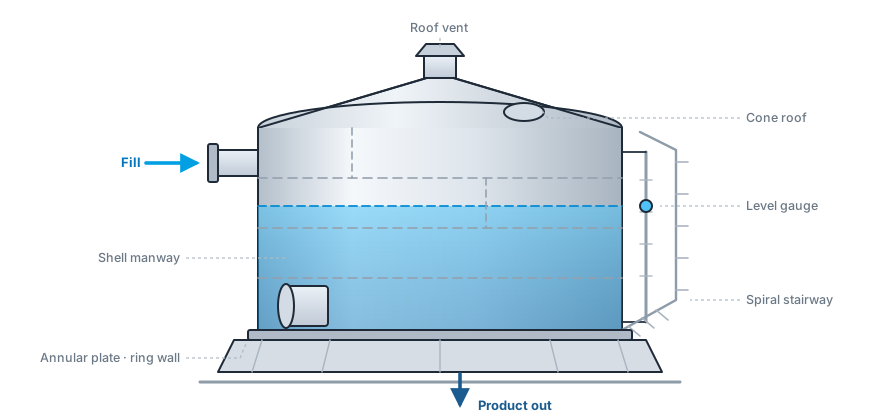
In practice, tank problems start at the bottom-to-shell joint, at the vent, or at the foundation. Those are the details we spend the most time on.
- Shell courses thickness stepped down with height, because the hydrostatic head reduces
- Annular bottom plate thicker ring under the shell where the bending stress concentrates
- Roof cone, dome or flat; frangible roof-to-shell joint where over-pressure protection is needed
- Venting sized for both filling and emptying, plus thermal breathing — a blocked vent collapses a tank
- Nozzles fill, outlet, drain, overflow, level, temperature, sample and CIP connections
- Manways shell and roof access for internal cleaning and inspection
- Access spiral or straight stairway, roof walkway and handrail to a recognised standard
- Foundation interface ring wall or slab detail, with the correct bearing and drainage under the plate
Which code applies
API 650, API 620 or ASME VIII
Pressure decides it. Get this wrong at enquiry stage and the whole design changes later.
| Code | Internal pressure | Typical use | Notes |
|---|---|---|---|
| API 650 | Essentially atmospheric — a very small gas-space pressure only | Water, fuel, chemicals, most bulk liquid storage | Welded, vertical, flat-bottom, above-ground tanks |
| API 620 | Low pressure, up to about 1 barg gas space | Refrigerated and low-pressure product storage | Allows a wider range of geometries than 650 |
| ASME VIII Div. 1 | Above roughly 1 barg | Anything genuinely pressurised | Then it is a pressure vessel, not a tank |
| API 653 | — | Inspection, repair, alteration and reconstruction | The standard for assessing and fixing an existing tank |
Shop-built
Fully fabricated, tested and coated in the shop, then delivered complete. Better quality control and faster site work, limited by what the road can carry — generally up to about 3.5 m diameter for standard transport.
Field-erected
Plate and pre-fabricated sections shipped to site and welded in place. The only option above transport limits, and it brings site welding, site NDT and a site weather window into the programme.
Linings & coatings
Cheaper than the alloy, when it is the right call
A lined carbon steel tank often beats a solid alloy tank on cost. It also introduces a maintenance item, so it is a decision worth making deliberately.
Epoxy & novolac linings
Chemical resistance for a wide range of services, and the usual choice for potable water where a certified system is required.
Rubber lining
Natural or synthetic rubber for acid service and for abrasive slurries where a hard coating would chip.
Glass flake & vinyl ester
High-build, low-permeability systems for aggressive chemical duty and hot immersion service.
Hot-dip galvanising
External protection for structural parts and smaller tanks in humid or coastal atmospheres.
External paint systems
Blast, prime and topcoat to a specified standard, with a coating schedule and DFT record.
Insulation & cladding
Mineral wool or PIR with aluminium or stainless cladding to hold temperature and protect personnel.
Design envelope
Specification options
Need storage capacity?
Tell us the volume, the fluid, the temperature and whether it is shop-built or on site.